
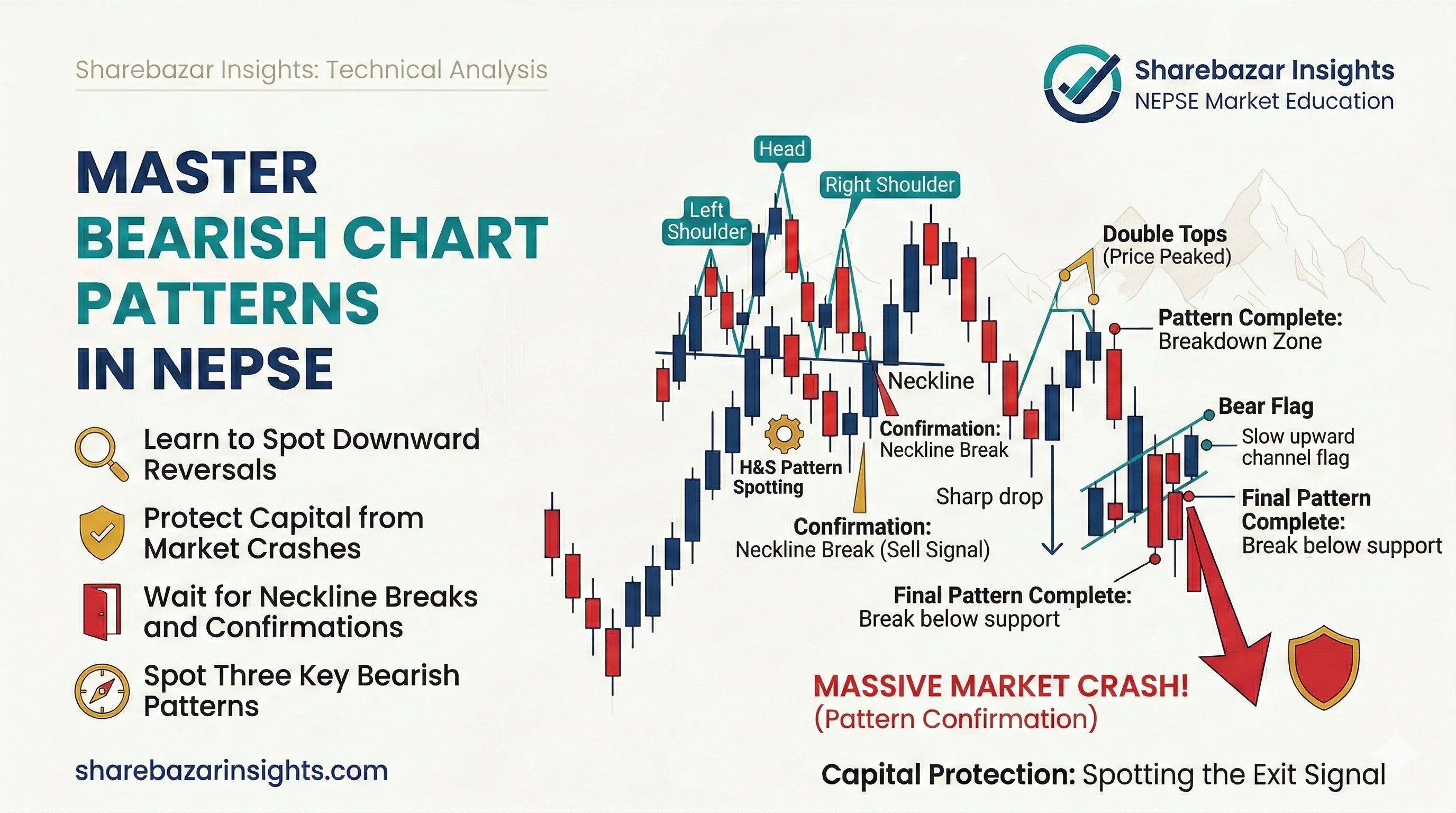
In the Nepal Stock Exchange (NEPSE), your success isn't just about knowing what to buy; it is about knowing when to sell. Because we do not have short-selling in our market, a bearish trend means only one thing: your capital is at risk.
When the market sentiment shifts from greed to fear, you need to recognize the warning signs before the crowd starts panic-selling. Bearish chart patterns are the visual footprints of smart money exiting the market. By learning to spot these setups, you can lock in your profits, trigger your stop losses in time, and protect your hard-earned capital from a devastating crash.
Let's break down the top bearish patterns every laganikarta needs to know, split into two categories: Reversals (when an uptrend dies) and Continuations (when a downtrend takes a brief pause before dropping further).
🔴 Bearish Reversal Patterns: Spotting the Top
These patterns form at the peak of a bull rally. They signal that the buyers are completely exhausted, institutional investors are distributing their shares, and a major downtrend is imminent.
1. The Double Top
The Double Top looks like the letter "M". The price hits a high, drops to form a support (neckline), and rallies back to the exact same high before facing massive rejection.
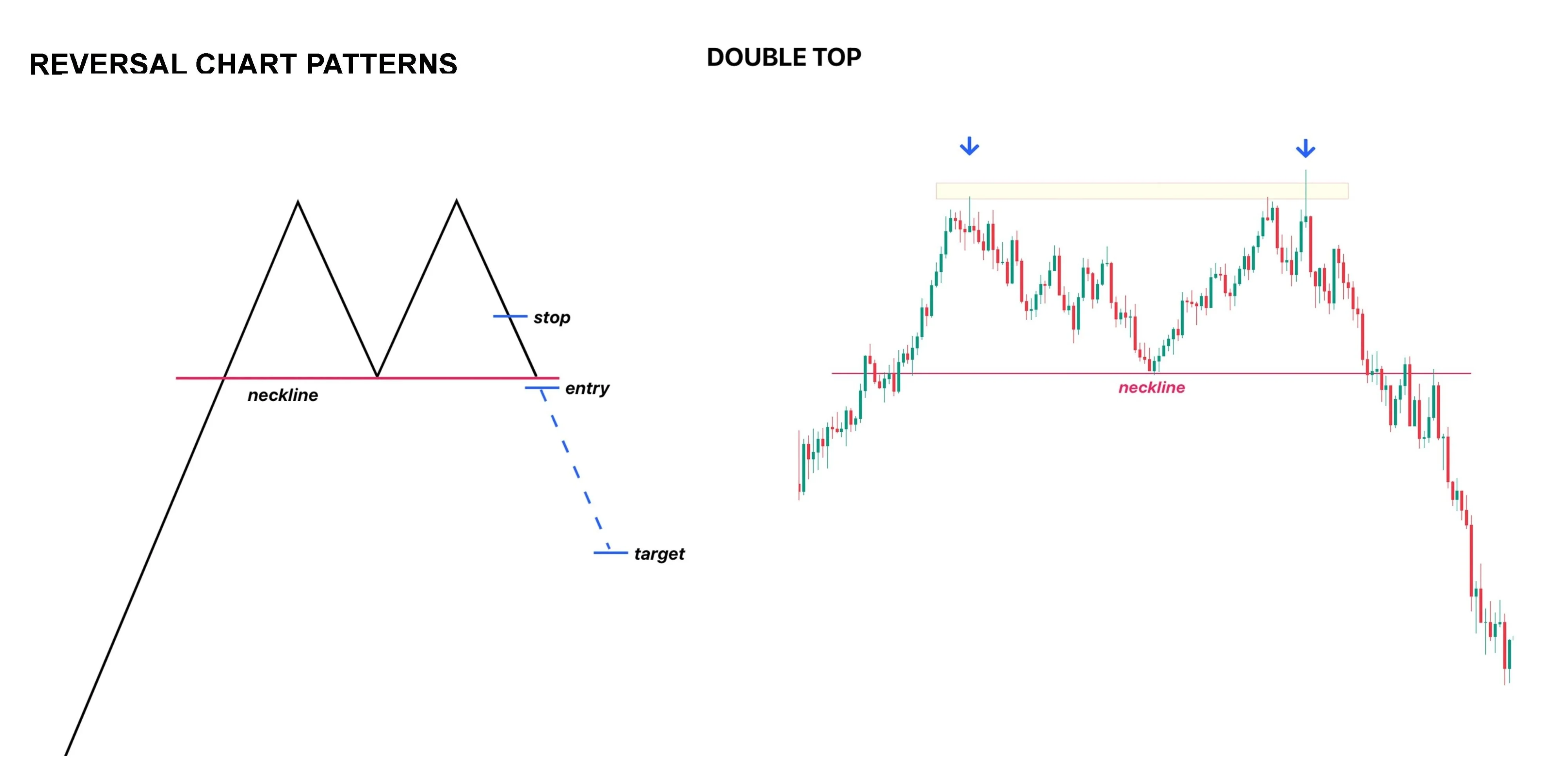
The NEPSE Context: Buyers tried twice to break a price ceiling and failed. The upward momentum is dead.
🎯 Next Move for Laganikartas: A breakdown below the neckline is your signal to exit.
➡️ Read our full guide on how to spot the Double Top exit signal here.
2. Head and Shoulders
This classic pattern features three peaks: a high peak (the Head) sandwiched between two lower peaks (the Shoulders).
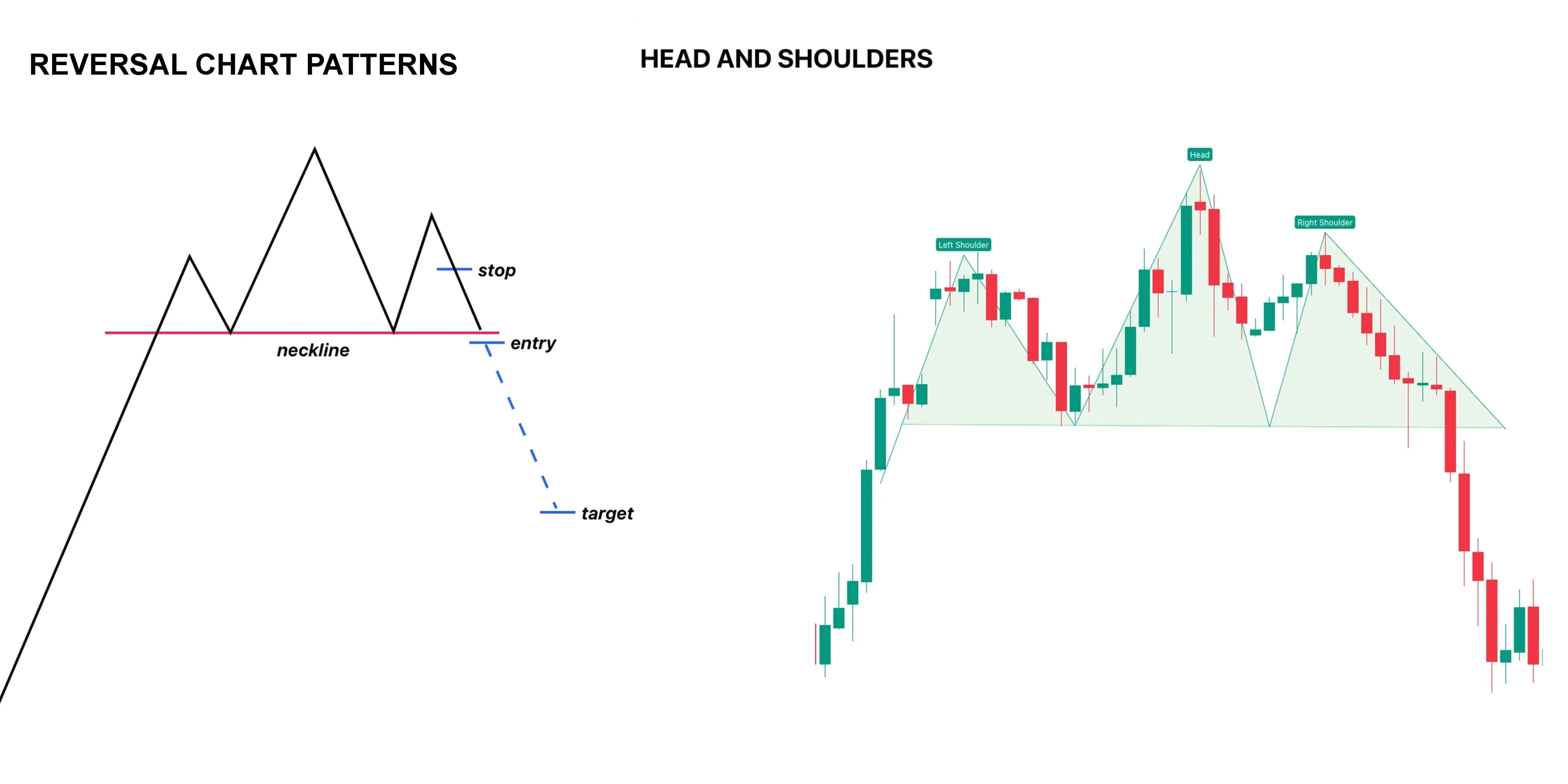
The NEPSE Context: The formation of the lower "right shoulder" proves that buyers are so weak they cannot even push the price back to its previous high. The sellers have taken control.
🎯 Next Move for Laganikartas: Draw the neckline connecting the bottoms of the peaks. If the daily candle closes below it, sell immediately.
➡️ Discover the step-by-step breakdown of the Head and Shoulders pattern here.
3. Rising Wedge
A Rising Wedge forms when the price is slowly grinding upward, but the trading range is getting tighter and tighter, forming an upward-pointing cone.
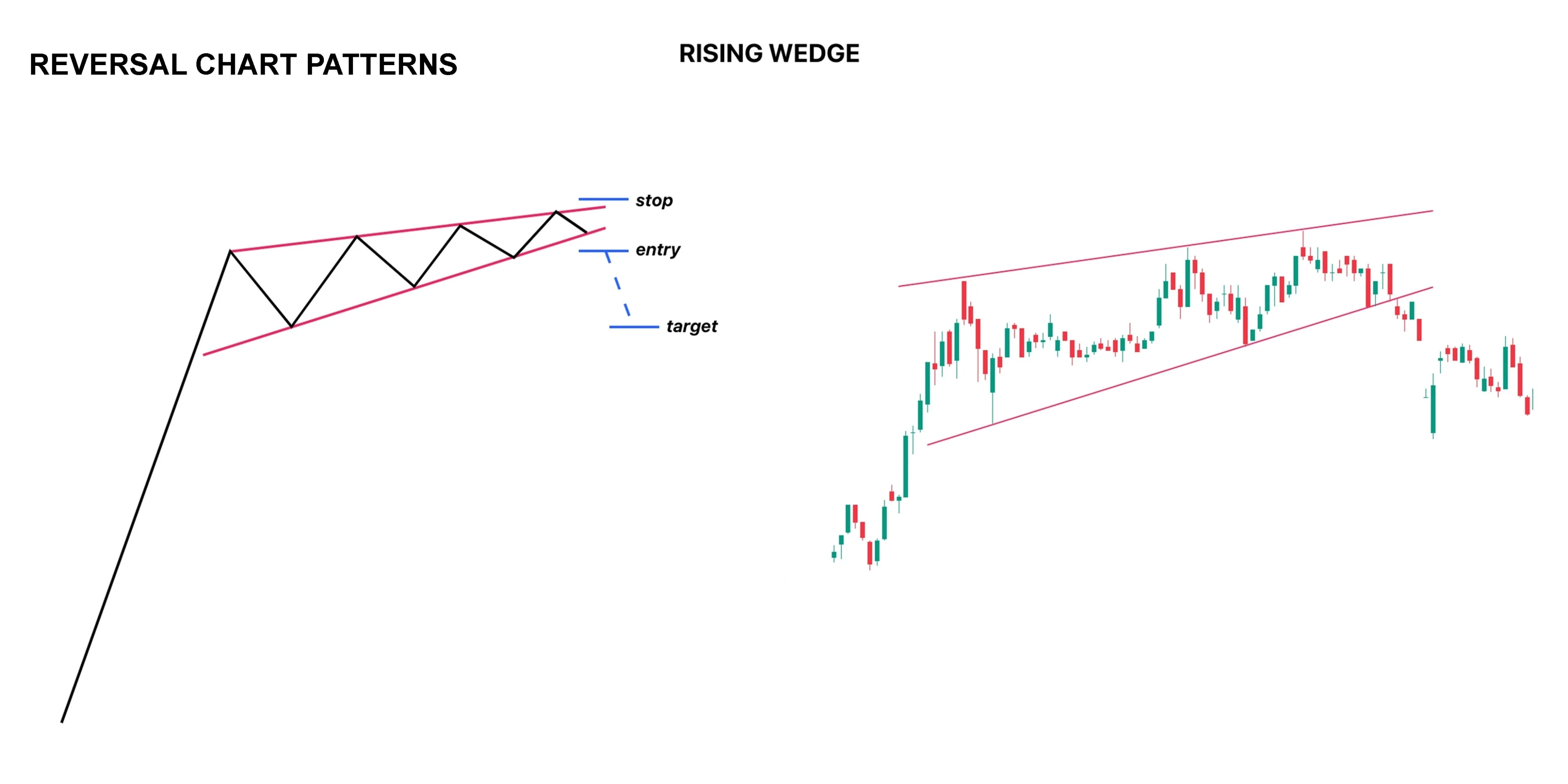
The NEPSE Context: Even though the price is technically rising, the buyers are struggling. The momentum is visibly slowing down, creating a "squeeze" that usually results in a violent downward crash.
🎯 Next Move for Laganikartas: Watch the lower support line closely. A break below it means the buyers have finally given up.
📉 Bearish Continuation Patterns: The Fake Bounces
When the NEPSE is already in a heavy downtrend, you will occasionally see small, green days. Many amateur investors mistake these for trend reversals and buy the dip. Bearish continuation patterns help you recognize that these are just "dead cat bounces" before the stock drops even lower.
1. Bear Flag
After a massive, steep price drop (the flagpole), the stock slowly drifts upward in a tight, parallel channel (the flag) as a few brave buyers try to catch the bottom.
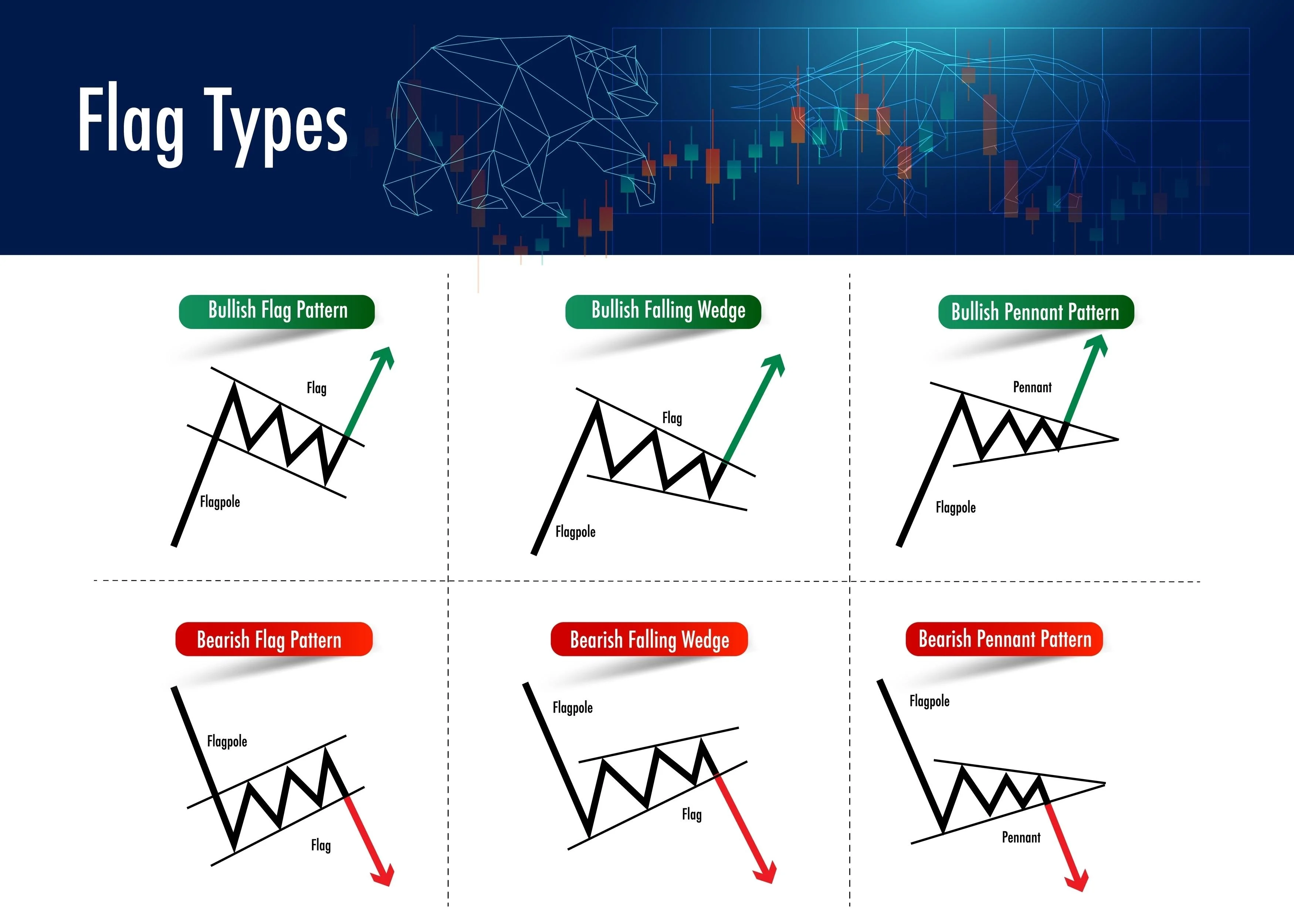
The NEPSE Context: This is not a reversal; it is just a brief pause. The selling pressure is still dominant. Once the price breaks out of the lower trendline of the flag, the crash resumes.
🎯 Next Move for Laganikartas: Do not buy this bounce. If you are still holding shares, use this upward drift to exit your positions at slightly better prices.
2. Bearish Pennant
Similar to the Bear Flag, this pattern follows a massive drop. But instead of drifting upward, the price consolidates into a tiny, tight symmetrical triangle over just a few days.
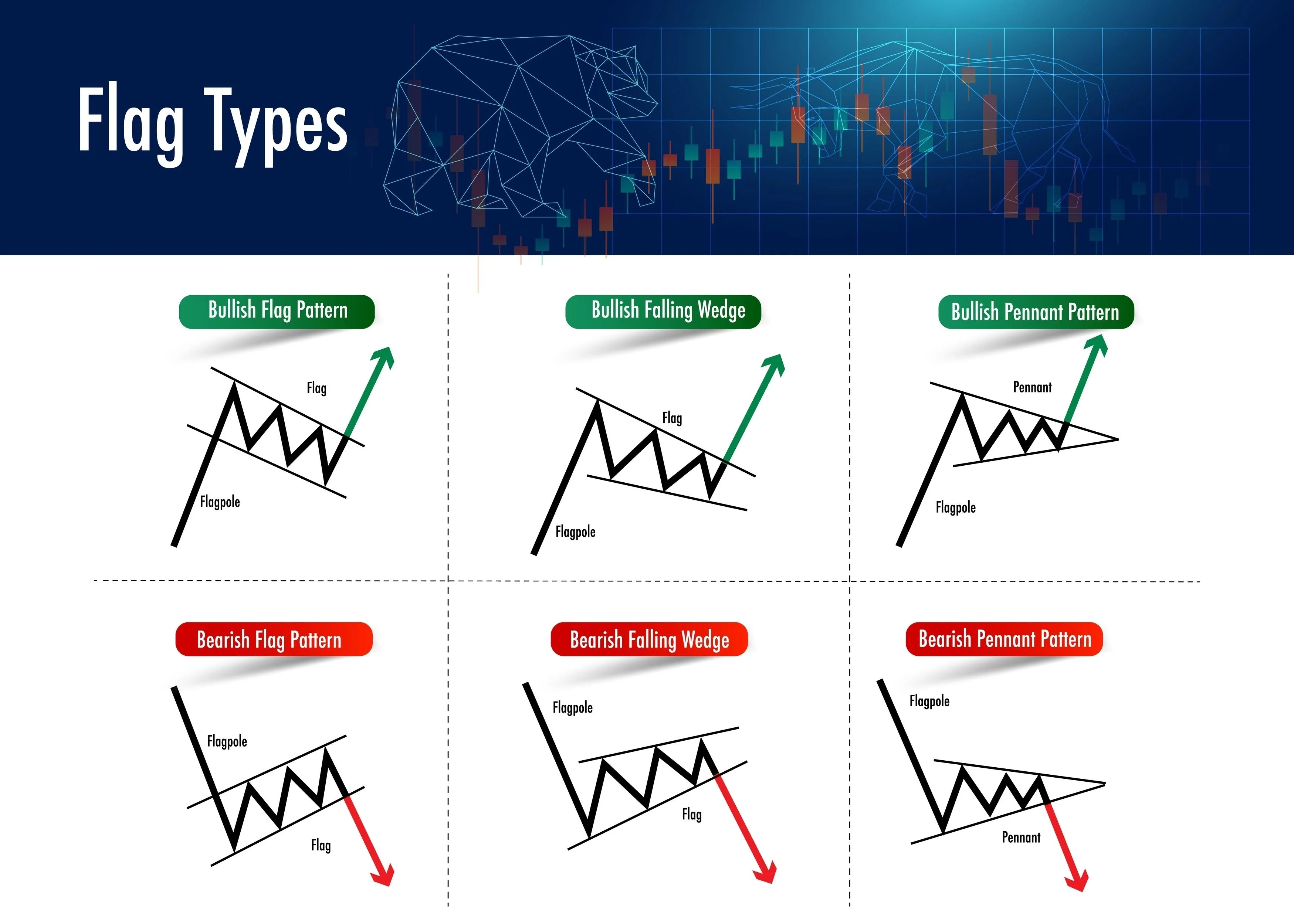
The NEPSE Context: Sellers are taking a very brief rest, but the aggressive downward pressure is squeezing the price. When it breaks the bottom trendline, the stock usually drops an equal distance to the initial crash.
🎯 Next Move for Laganikartas: Prepare for high volatility. This is a sign to stay far away from buying this scrip.
➡️ See real examples of Bearish Pennants causing massive sell-offs in NEPSE here.
3. Descending Triangle
This pattern has a flat, horizontal support line on the bottom and a falling resistance line on top.
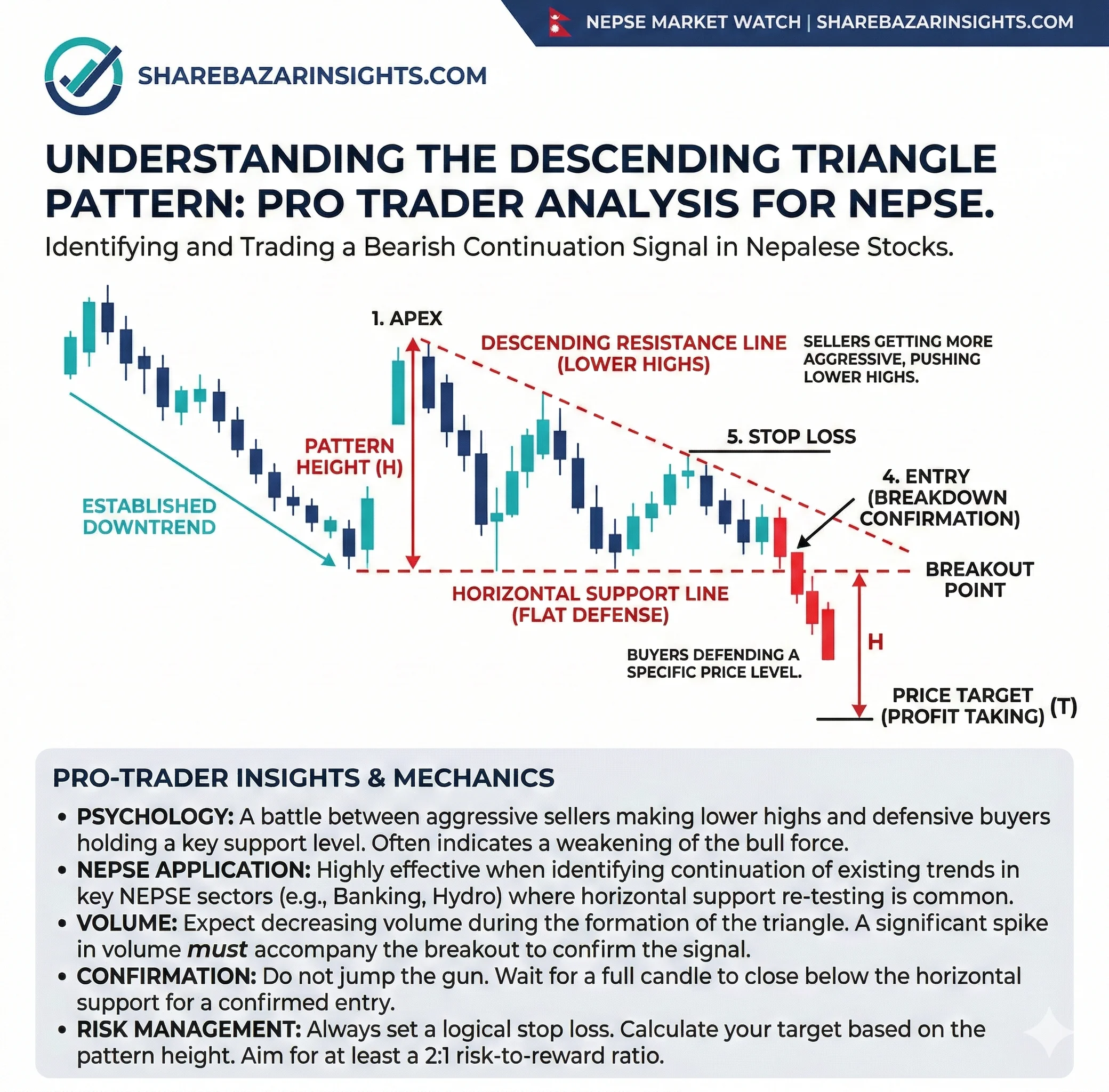
The NEPSE Context: Buyers are desperately trying to defend a specific floor (support), but sellers are getting more and more aggressive, creating lower highs. Eventually, the buyers run out of cash, and the floor collapses.
🎯 Next Move for Laganikartas: If a stock is repeatedly hitting the same support but making lower highs, it is a ticking time bomb. Exit before the support breaks.
➡️ Learn how to spot a Descending Triangle before the floor gives out here.
💡 Since we cannot short-sell, bearish patterns are your best friend for capital preservation. Cash is also a position in the market! When you see these patterns confirmed, selling and holding cash is the smartest trade you can make.