
The Bearish Spinning Top: Why This "Pause" in a NEPSE Downtrend is Usually a Trap
The Dangerous Illusion of Stability
When the Nepal Stock Exchange (NEPSE) is in the middle of a punishing downtrend, traders are desperate for any sign of relief. We watch the red candles pile up day after day, and we keep asking: "Is this the bottom? Is it time to enter?"
Then, one day, the aggressive selling stops. The market opens, wobbles up a bit, wobbles down a bit, and closes near where it started, forming a small red candle.
Many impatient traders look at this and think, "Ah, the selling has stopped. The market has stabilized. Time to buy the dip!"
More often than not in NEPSE, this is a trap.
You have likely just spotted a Bearish Spinning Top. In the context of a falling market, this isn't a sign of a reversal; it is merely a "pause before the drop"—a brief moment for sellers to catch their breath before they push prices even lower.
Identifying the Bearish Spinning Top
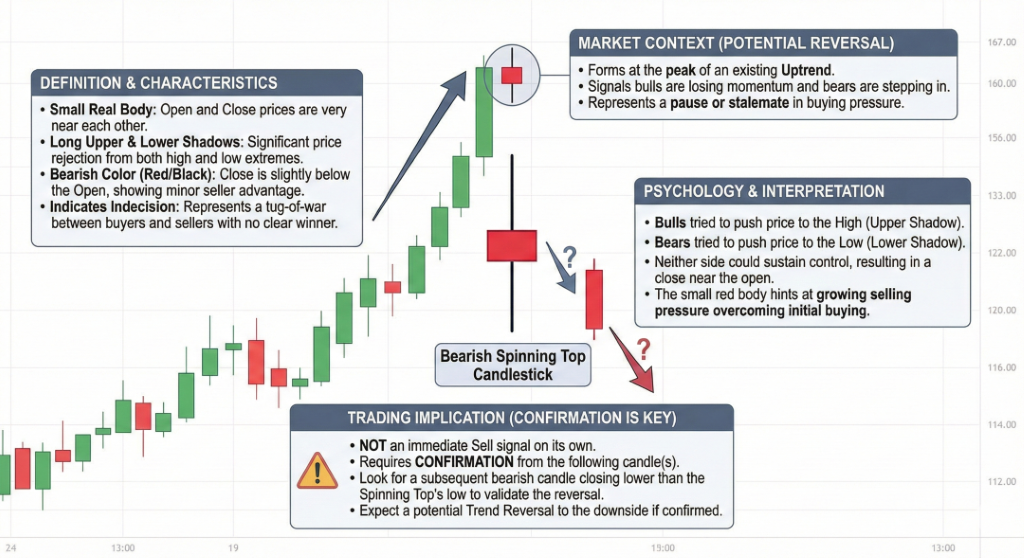
The Spinning Top gets its name because it looks like a child's spinning top toy. It represents indecision in the market.
The Visual Checklist:
The Context (Crucial): The stock or index must already be in a clear downtrend. If the market is going sideways, this pattern means very little.
The Body: It has a very small "real body" centered in the middle of the day's range. Because it is a bearish spinning top, this body must be red (the close was slightly lower than the open).
The Shadows: It has an upper shadow and a lower shadow of roughly equal length.
It looks like a small red square with a stick poking out of both the top and the bottom.
The Psychology: The "Breather"
Why is indecision bearish in a downtrend?
Imagine a heavy object rolling downhill. It has momentum. If it hits a small flat patch of ground, it might slow down momentarily, but unless something pushes it back up the hill, gravity will take over again, and it will continue rolling down.
The Bearish Spinning Top is that flat patch of ground.
During the day: The bears tried to push prices lower, but took a break. The bulls tried to push prices higher, but didn't have the conviction to sustain it.
The Result: A draw. But because the body is red, the bears still "won" the day slightly.
In a NEPSE downtrend, this signals that the buyers are still too weak to turn the tide. The sellers haven't left the market; they are just resting.
The NEPSE Trap: Don't Mistake a Pause for a Bottom
In our one-way market where we can only profit from buying, the temptation to anticipate the bottom is immense.
The Bearish Spinning Top is dangerous because it looks like stability. After three days of big red candles, a small Spinning Top feels safer.
But professional traders know that a trend in motion is likely to stay in motion. A pause is just a pause. If you buy during a Bearish Spinning Top in a downtrend, you are likely buying just before the next wave of selling hits.
Your Action Plan: Patience Pays
If you are sitting on cash, waiting to deploy it into a falling market, and you see this pattern appear:
1. Do Not Buy Yet Treat this candle as a "wait and see" signal, not an "enter" signal. The market has not given you any proof that buyers are ready to take control.
2. Watch the Low Mark the lowest point of the Spinning Top's lower shadow. This is your support level for the next day.
3. The Confirmation (The Drop) If the market opens the next day and breaks below that low point you marked, the "pause" is over. The downtrend has resumed. If you had bought yesterday, you would already be trapped in a loss.
Conclusion
Mastering technical analysis in NEPSE isn't just about knowing when to jump in; it's about having the discipline to know when to stand aside.
The Bearish Spinning Top in a downtrend is the market's way of saying, "We aren't done going down yet." Don't let a temporary pause fool you into catching a falling knife. Wait for a real reversal signal, like a strong green candle or a Hammer, before risking your capital.