

Deep Dive: How to Trade the Hammer Pattern in NEPSE
If you’ve read our overview on Single-Candle Patterns, you know that the Hammer is the ultimate signal of a "bullish rejection." But seeing a Hammer is only half the battle. Knowing how to trade it—where to enter, where to set your stop loss, and when to take profit—is what separates the amateurs from the pros in the Nepal Stock Exchange.
In this deep dive, we’ll break down the exact strategy for trading the Hammer in the context of NEPSE.
The Anatomy of a High-Probability Hammer
Not all Hammers are created equal. In NEPSE, a high-probability Hammer must meet these criteria:
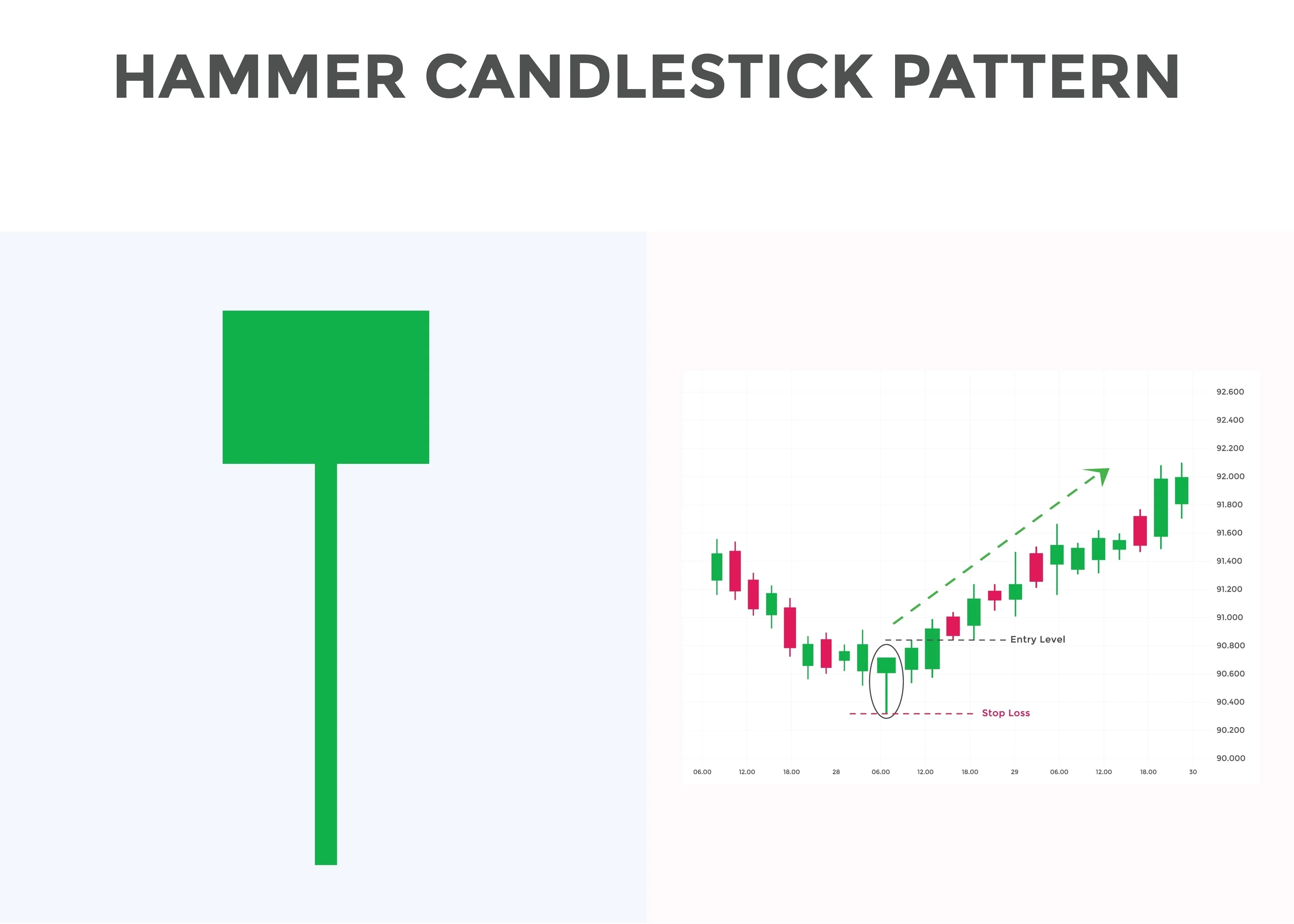
The Lower Shadow: Must be at least two to three times the length of the real body. This shows a massive rejection of lower prices.
The Real Body: Can be green (bullish) or red (bearish), but a Green Hammer is statistically more powerful in our market.
The Trend: It MUST appear after a clear downtrend or a sharp correction (common in Hydro and Finance sectors). A Hammer in the middle of a sideways market is noise—ignore it.
Step-by-Step Trading Strategy
1. Identify the "Value Zone"
Don't trade a Hammer in isolation. Look for it to form near:
Previous Support: Look at the horizontal support lines where the stock bounced before.
Moving Averages: The 50-day or 200-day EMA often acts as a floor for NEPSE stocks.
Psychological Numbers: In NEPSE, whole numbers like 1800, 2000, or 2200 often act as invisible magnets.
2. The Entry (The Confirmation)
This is the most common mistake. Traders buy as soon as they see the candle.
The Rule: Wait for the Confirmation Candle.
Action: Enter a "Buy" order only when the next candle breaks and closes above the high of the Hammer. In Nepal's T+2 system, being patient with your entry is crucial to avoid "false breakouts."
3. Placing the Stop Loss
Trading without a stop loss in NEPSE’s volatile environment is a recipe for disaster.
Location: Place your stop loss 2–3 points below the lowest tip of the Hammer's wick (the shadow).
Logic: If the price falls below the Hammer's wick, the "Smart Money" has failed to defend that level, and the bullish thesis is invalidated.
4. Taking Profit (The Target)
In our market, resistance often comes fast.
Primary Target: The nearest previous "swing high" or resistance level.
Secondary Target: A 1:2 risk-to-reward ratio. If your risk (entry to stop loss) is 10 points, aim for a 20-point gain.
A Real NEPSE Example: The Hydro Bounce
Imagine a popular Hydropower stock (e.g., UPPER or AHPC) has dropped from Rs. 500 to Rs. 420.
Day 1: A Hammer forms at Rs. 415 (near a known support level).
Day 2: The stock opens and stays above Rs. 425 (the Hammer's high). This is your entry.
Stop Loss: Rs. 412 (just below the wick).
Result: The stock rallies back toward the Rs. 460 resistance level.
Pro Tip for Sharebazar Insights Users: Volume is King
In NEPSE, watch the Volume. A Hammer on low volume is often a "dead cat bounce." A Hammer accompanied by a spike in volume means institutional players are actually buying, making the reversal much more likely to hold.